

60% of employees will need significant reskilling in the coming years and half of the skills considered critical today will be obsolete or profoundly transformed in less than five years. This is not a distant statistic: it is the operating framework in which any HR director, CHRO, or executive committee is already making talent investment decisions. The question is no longer whether to invest in training. The question is what type of training, for whom, and in what order. And this is where two concepts appear that need to be distinguished with precision: reskilling and upskilling.
At CAE we have spent more than forty-five years accompanying large organizations in the transformation of their training capabilities. And we have seen how the emergence of generative artificial intelligence, in less than three years, has accelerated all the anticipated timelines for talent transformation. This article is a strategic synthesis of the difference between reskilling and upskilling, of when each strategy is appropriate, of how to combine them in an effective hybrid model, and of which mistakes should be avoided when deploying them. Aimed at those who decide corporate training budgets, not at those who execute them operationally.
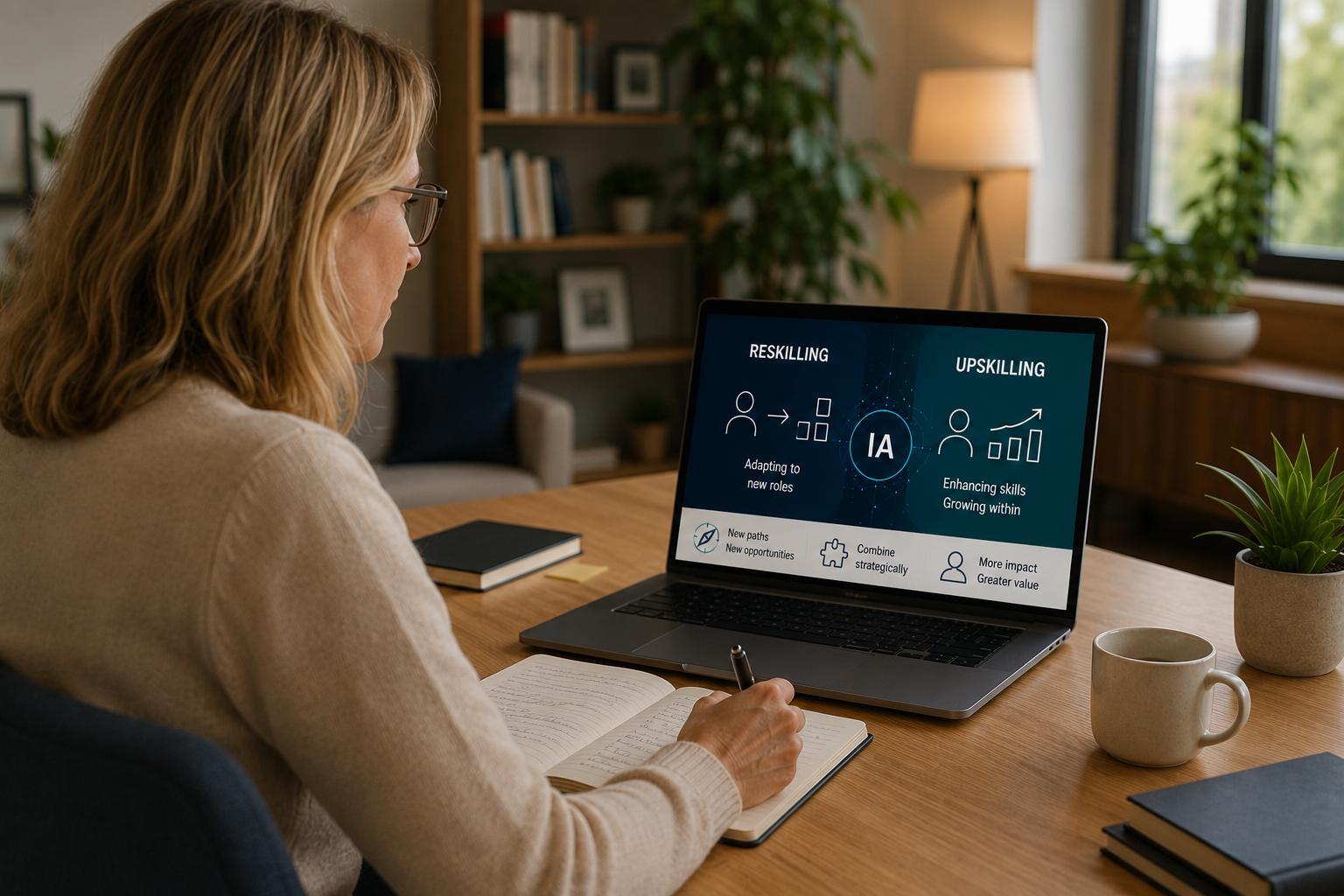
Reskilling and upskilling: two strategies, two different logics
Confusion between the two terms is common even in serious industry reports. It is worth establishing the difference precisely, because the operational, budgetary, and cultural implications are radically different.
What is upskilling
Upskilling is the incremental improvement of skills an employee already possesses, deepening or expanding what they already know how to do within their current professional field. A financial analyst who learns predictive analytics with AI, a salesperson who incorporates advanced consultative selling techniques, a middle manager who trains in leading hybrid teams. In all cases, the employee continues to perform essentially the same role, but does it better, with new tools and greater depth.
What is reskilling
Reskilling is deep requalification toward a role different from the one the employee currently performs. An administrative assistant who trains as a data analyst, a production technician who transitions into predictive maintenance, a sales agent who becomes a digital consultant. The change here is not one of depth: it is one of nature. The organization keeps the employee but transforms their function.
The seemingly subtle distinction has enormous consequences. Upskilling is planned in months; reskilling in years. Upskilling preserves the employee’s professional identity; reskilling transforms it. Upskilling is funded with ordinary training budgets; reskilling requires specific investment and, frequently, psychological support for the change.
Why artificial intelligence has accelerated the urgency of both strategies
The most relevant industry reports, such as the Future of Jobs Report from the World Economic Forum, have for years been pointing to a trend that has become consolidated in recent months: generative artificial intelligence is not eliminating jobs at the pace some alarmist predictions anticipated, but it is transforming the internal nature of practically all positions. Tasks that formed the core of many administrative, technical, and even management roles are now partially automated. This shifts the employee’s added value toward different capabilities: judgment, complex communication, AI oversight, integration of ambiguous information.
Sector analysis from consultancies such as McKinsey agree in identifying a dual pressure on corporate talent. On one hand, most existing positions urgently require upskilling to incorporate new tools and maintain productivity. On the other hand, a significant proportion of mid-level employees will need full reskilling because their role is going to change substantially, no longer as a future threat but as an operational reality of the next twenty-four months.
The strategic implication is clear: no organization can limit itself to just one of the two strategies. One that bets only on upskilling will fall short when the transformation of some roles becomes inevitable. One that bets only on reskilling will lose immediate productivity by neglecting the improvement of talent that is already performing. The right question is how to combine them, not which one to choose.
When to prioritize upskilling and when to prioritize reskilling
Before laying out the combined model, it’s worth being clear about the scenarios in which each strategy is the primary response.
Three scenarios where upskilling is the priority
First, when the employee’s role will retain its essential nature but will require new technical or digital skills. For example, the finance department will remain finance, but needs to incorporate predictive analytics with AI, process automation, and new data visualization capabilities.
Second, when the employee has deep experience in a function and the organization wants to capitalize on that knowledge by adding complementary capabilities. Here upskilling is the return lever: the investment is smaller than reskilling and the performance is immediate because it builds on what already works.
Third, when the organization needs to raise the general skill level across all employees simultaneously. Typical examples are widespread training in digital literacy, basic cybersecurity, or responsible AI use. Mass upskilling is the strategic tool for creating a baseline of skills across the entire workforce.
Three scenarios where reskilling is the priority
First, when a role is in structural decline and the employee, due to experience and commitment to the organization, deserves to be redirected toward future-oriented functions. This is the most humanly demanding decision and, frequently, the most profitable in the long run.
Second, when the organization has a critical shortage of emerging profiles that the external market cannot provide quickly enough. Training these profiles internally, when the market takes months to supply them, can be faster and cheaper than external hiring, especially for very specific profiles.
Third, when corporate culture makes internal mobility a differentiating value. Organizations that invest in systematic reskilling strengthen the psychological contract with their employees and significantly reduce talent attrition.
How to combine reskilling and upskilling in a coherent strategy
The operational question any talent leader asks is how to articulate both strategies without overlap, without cannibalizing each other, and without blowing up the budget. These are the four principles underpinning an effective combined model.
First principle: rigorous segmentation of the talent map
Not all employees need the same thing. The organization must be able to answer, with data, which roles are going to transform deeply (candidates for reskilling), which roles are going to evolve by incorporating new skills (candidates for intensive upskilling), and which roles require a light update (general upskilling). Without this segmentation, the training plan is generic and therefore ineffective.
Second principle: clear separation of budgets and metrics
Reskilling and upskilling must have their own budget lines and distinct success metrics. Upskilling is measured by incremental productivity and skill retention; reskilling by successful transition rate to the new role and by value generated in the new function. Mixing both measurements into a single report produces confusing analysis and flawed decisions.
Third principle: modular training architecture
The operational piece that sustains the combined model is a modular training catalog capable of serving both upskilling (with short, applied learning paths) and reskilling (with long, progressive learning paths) at the same time. At CAE we have designed the LearningHub catalog precisely under this logic: more than 130 pieces of content organized by cross-functional areas, combinable into different learning paths depending on each employee’s training goal and each moment of the strategic plan.
Fourth principle: governance shared with business leadership
Strategic reskilling and upskilling decisions should not be made exclusively within Human Resources. They must be governed jointly with business leadership, who have real visibility into how each function is evolving. This shared governance is the difference between training plans that get implemented and plans that stay on paper.
The four mistakes that empty out any reskilling and upskilling strategy
It’s worth naming the most recurring mistakes we observe in organizations that have tackled this process without prior method.
The first mistake is treating reskilling and upskilling as synonyms. When everything is labeled “continuous training,” the organization loses the ability to prioritize, budget properly, and measure return separately.
The second mistake is launching reskilling plans without human support. Role transformation is an emotionally complex process. Plans that are reduced to publishing courses on the platform, without mentoring, without periodic conversation with the manager, and without psychological support, fail at a very high rate.
The third mistake is underestimating mass upskilling in cross-functional skills. The organization dedicates resources to highly sophisticated individual programs and neglects the baseline. The result is a workforce with a few peaks of excellence and a broad middle with basic gaps that limit the whole operation.
The fourth mistake is not measuring transfer to the job. Many reskilling and upskilling plans are measured by course completion, not by application at work. Without this second measurement, there is no way to know whether the strategy is working or whether resources are being consumed without return.
CAE’s role in reskilling and upskilling strategies
At CAE we support large companies and distribution partners in designing and executing combined training strategies. Our active-practice-based learning methodology, supported by artificial intelligence that adds value, is designed to sustain both the incremental improvement of upskilling and the deep requalification of reskilling. The difference between the two, from a training-design point of view, lies not in the tool but in the depth of the learning path, the pace of practice, and the intensity of support.
Organizations that pursue both strategies simultaneously achieve a higher return than those that opt for only one path, according to analyses by bodies such as the OECD in its reports on talent transformation. The condition is having a training architecture versatile enough to sustain both approaches without duplicating investment or fragmenting the employee experience.
Frequently asked questions
What is the essential difference between reskilling and upskilling?
Upskilling improves skills within the same role; reskilling transforms the employee toward a different role. The first preserves the employee’s professional identity; the second changes it. The first is planned in months; the second, in years.
What percentage of the training budget should be allocated to each strategy?
It depends on the organization’s strategic moment. In organizations undergoing deep transformation, the usual allocation places between 30% and 50% of the budget in reskilling and the rest in upskilling. In more stable organizations, the proportion is reversed. The key criterion is not the initial proportion but the periodic review.
How long does a deep reskilling process take?
Between 12 and 24 months for a real transition to the new role, including training, supervised practice, and consolidation. The fastest processes tend to produce formal transitions without real transfer, and the slowest ones lose employees due to demotivation. The sweet spot is 12-18 months with good support.
Can reskilling and upskilling be combined in the same employee?
Yes, and in fact it’s common. An employee can be in a reskilling process toward a new role and, simultaneously, complete upskilling in cross-functional skills applicable to both their current role and their future one. The key is sequencing priorities well.
Is this model compatible with subsidized training such as FUNDAE?
Yes. Both strategies generate subsidy-eligible training actions if they meet the requirements for duration, traceability, and evaluation. Reskilling, since it involves longer learning paths, usually allows for more systematic use of the training credit.
Conclusion: talent strategy is no longer optional, it is the organization’s central decision
For decades, corporate training was perceived as an internal service: desirable, improvable, but secondary to central strategic decisions. That perception is no longer sustainable. In a context where artificial intelligence is redefining half of any organization’s critical skills in less than five years, deciding which employees are trained in which direction and at what pace is, literally, the most important strategic decision any executive committee makes.
Reskilling and upskilling are not two options to choose between: they are two levers that must be combined with judgment according to the strategic moment, each employee’s profile, and the transformation the organization is pursuing. And that combination, well designed, is what differentiates companies that are going through the AI era strengthened from those being overwhelmed by it.
At CAE, after forty-five years, we remain convinced that corporate training is one of the most profitable strategic assets an organization can build, especially in times of accelerated transformation. And that this profitability materializes only when the training plan is designed with the same seriousness as any other central investment decision.
Would you like to know how we design combined reskilling and upskilling strategies for organizations like yours? Contact our team for an initial conversation about your specific context.